
East Lansing Previous Residents by Era
Start the backward trail with the source that fits the era. Land records explain an ownership change, but they do not prove an everyday address connection. CADL address listings, federal census schedules, and local house-history material supply different kinds of evidence. The ranges below are the documented access routes, not a promise that every year or address has a surviving entry.
| Source | Years it covers | Where held | What it shows |
|---|---|---|---|
| Ingham deed index and images | Index 1956 to current; older material at the counter | Register of Deeds, Direct Search, Tapestry, Mason vault | Grantor, grantee, instrument, date, and legal description |
| CADL street-address directories | Address listings 1906 to present | CADL Forest Parke and library databases | Published name and address entries for a year |
| Cross-index volumes | 1972 to 1996, except 1974 and 1975 | CADL and reference holdings | Reverse address-to-occupant clues |
| Federal census schedules | Individual schedules through 1950 | National Archives and library resources | Household-level snapshot and address context |
| Sanborn maps and local cards | Maps from listed historic years; Belon cards 1952 to 1970 | CADL, Library of Congress, and staff research | Building, number, lot, photo, or change context |
Current owner and parcel information come first because the legal description connects a modern address to an older deed even when the street number later changed.
Start East Lansing Previous Residents
Open the East Lansing BS&A property search with the present address. It supports address, owner-name, and parcel-number searches without charge. Capture the parcel number, owner, situs address, and available legal-description clues. Next, use the city's GIS map to compare the street geometry, neighboring parcels, and any parent-parcel or split relationship. Save the date of the card because the displayed ownership and values can change.
The owner mailing address is where tax correspondence goes. The situs is the physical parcel location. A difference between the two is not evidence that a named person did or did not live at the house. The parcel and legal description are the dependable handoff to the recorder.
East Lansing Previous Residents Deed Chain
The Ingham land trail runs backward through the party roles in a deed. Search the current owner as a grantee in Direct Search, find the acquisition document, then use the seller's name as the next grantee. Match the legal description before accepting a hit. Names can appear in different order, under a married name, estate, trustee, or business, so a name match alone is not enough.
- Record the current parcel number, owner, and legal-description clue from BS&A and GIS.
- Find the current owner as grantee and capture the recording date, document number, book and page, grantor, and instrument.
- Read the legal description, then search that grantor as grantee for the earlier acquisition.
- Repeat backward, checking the lot, block, unit, or other land description at every change.
- Move to the Register of Deeds vault or mail-copy route when the online path ends or conflicts.
- Grantor
- The party conveying an interest in the land in the recorded document.
- Grantee
- The party receiving that interest. In a backward search, the previous seller becomes the next person to search as grantee.
- Chain of title
- The sequence of recorded conveyances for the same land, checked by legal description rather than name alone.
- Legal description
- The lot, block, subdivision, unit, or metes-and-bounds land description used in deeds and plats. It survives address changes better than a street number.
Ingham Records for Earlier Owners
The Register of Deeds records page documents several paths. Direct Search is a free index from 1956 to the present, except the most recent seven days. The county describes online images as 1956 to current. It also warns that 1956 through 1981 conversions can contain discrepancies and states that 1982 forward is accurate. Check the Mason vault for the warned period even after an online match appears, and make a vault appointment for pre-1960 records.
Direct Search is the free index route shown here.
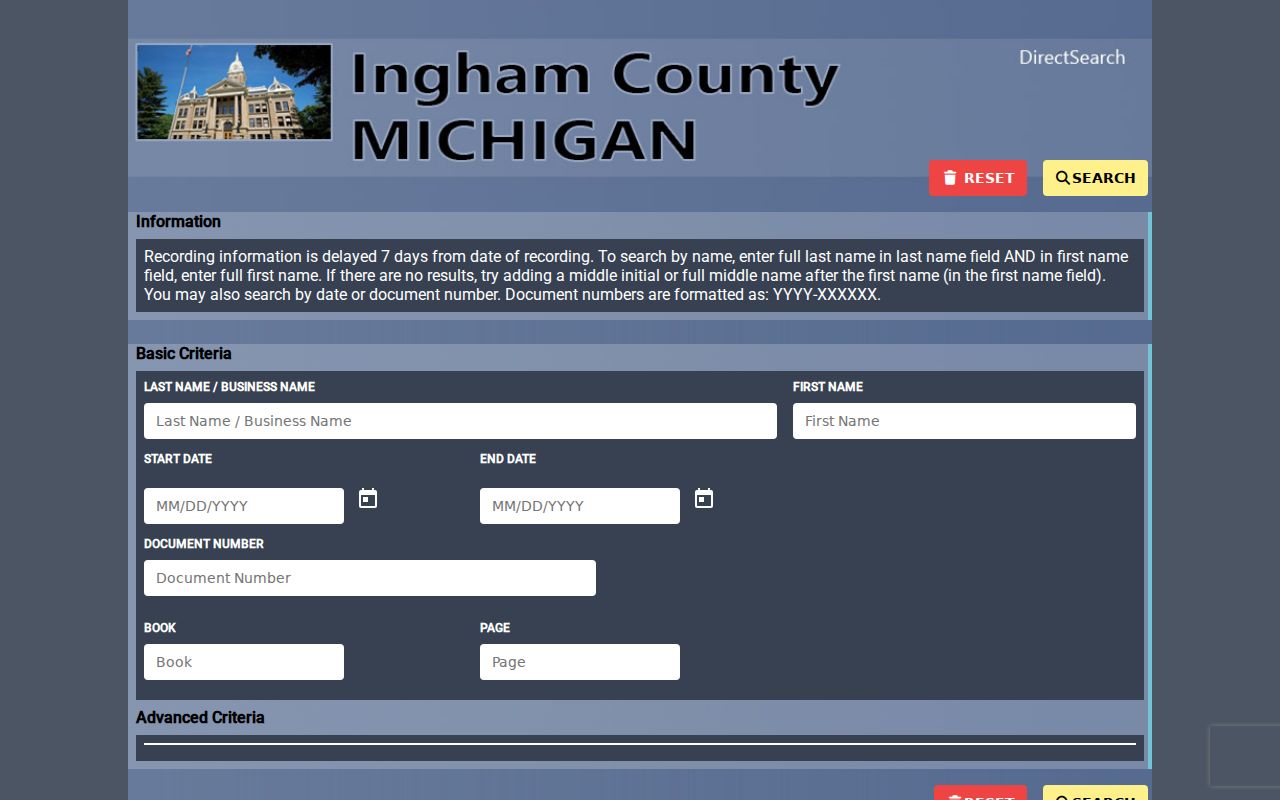
Use an owner name, property description, book and page, or document number to identify the relevant document before requesting a copy.
Tapestry's search service is the separate image-access route.
Tapestry lists images from 1960 to current and costs $8.95 per search plus $1 per page. Mail copies cost $1 per page and can be requested from P.O. Box 195, Mason, using the available identifying details.
East Lansing Previous Residents at CADL
CADL's house-history research page directs an address researcher to directories, Sanborn maps, digitized real-estate cards, and permit collections. The Belon real-estate cards are fully digitized for 1952 through 1970 and can include photographs. CADL also identifies construction-permit collections from 1923 through 1992. Ask staff for a scan when an item is not online. The reviewed sources did not locate a complete public permit search for the historic collection.
The CADL house-history source provides a local starting point for the non-deed part of a past-resident trail.
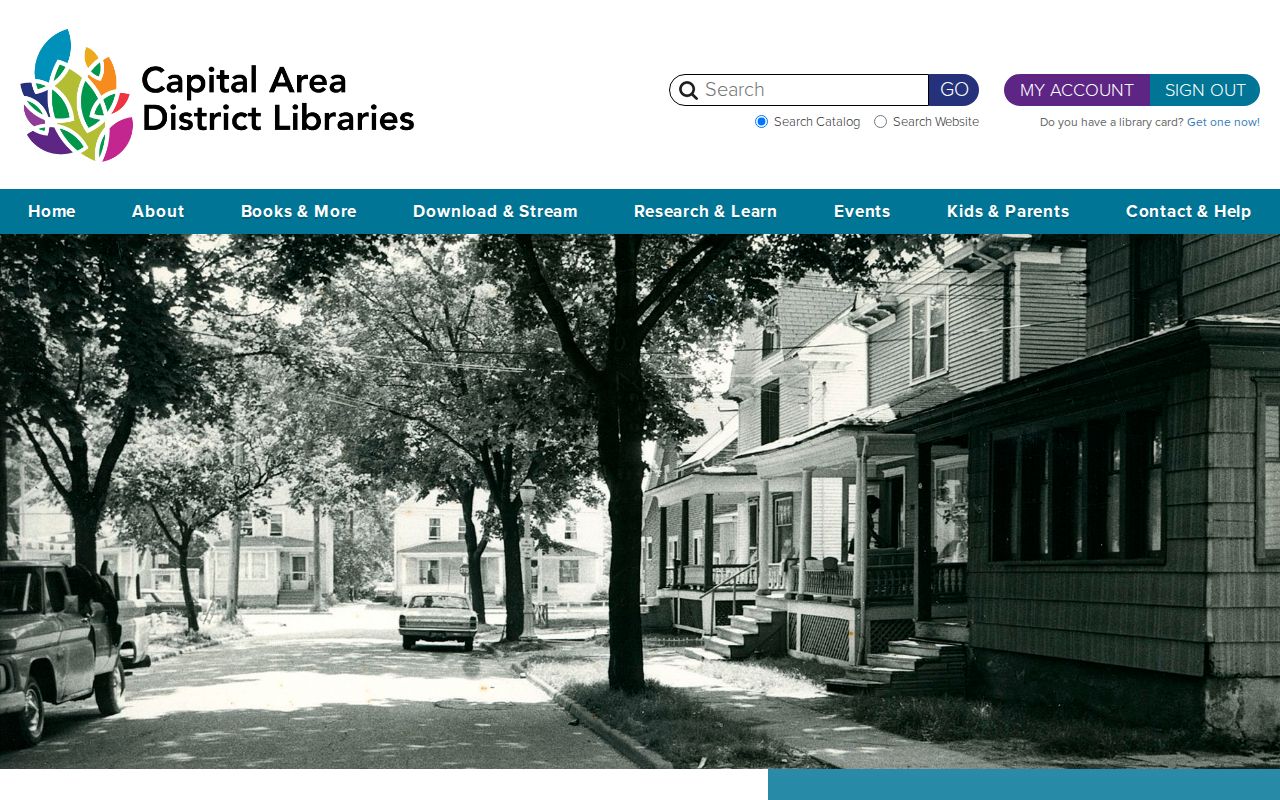
A card, directory entry, or permit can date a property clue. It should be paired with a deed or another dated source before identifying who lived there.
East Lansing Address Number Changes
Historic East Lansing research must account for three Lansing-area numbering systems. CADL places the first roughly between 1867 and 1883 without block divisions, the second about 1885 through 1905 with directional names and numbered blocks, and the Philadelphia or block plan from 1906 forward. There is no comprehensive key that converts an early number to the modern form. Record the original number and spelling instead of guessing a new address.
Sanborn maps are the bridge. CADL lists 1885, 1892, 1898, 1906, 1913, and 1926 editions; the Library of Congress 1926 volume republished in 1953 includes East Lansing and Meridian Township. Locate the old intersection, lot, or building footprint, then compare it to the modern parcel.
East Lansing Previous Residents in Directories
CADL's directory guide says street-address listings begin in 1906 and the criss-cross inventory covers Lansing and East Lansing from 1972 through 1996, with no listed volumes for 1974 and 1975. A reverse entry can place a publication-era occupant at an address. Copy the name, spelling, owner or occupant mark, spouse notation, occupation, and adjacent entry if shown. The broader shelves and publisher runs are described on the East Lansing city directory page.
For a household check, pair a directory year with the nearest federal census. Individual census schedules are public through 1950 under the 72-year release rule. The National Archives 1950 Census provides free schedules and maps. Census information can include household names, age, birthplace, marital status, occupation, and address context, but it is also a record of one census day.
East Lansing Past Resident Endpoints
When a property trail reaches a major change, an address-based permit may date construction or renovation, yet it does not establish who lived at the address. Obituaries, probate material, and county or state vital-record routes can help explain a move, death, or estate transfer. Keep the date and custodian with each finding. An estate name in a deed can be a reason to check probate, not a substitute for a household record.
East Lansing is chiefly in Ingham County, but a small northern portion is in Clinton County. Confirm the county when an address, event, or older jurisdiction points to the city edge. The right custodian depends on both record type and date.
East Lansing Previous Residents Limits
Previous residents research is useful for family history, a property timeline, and personal curiosity. It is not a complete account of every person connected with a house. A deed identifies recorded parties, a directory identifies a publication-era entry, and a census reflects one enumeration date. Sensitive fields, protected addresses, sealed records, and private utility data do not become available through a house-history search.
Michigan's Address Confidentiality Program uses a designated address for eligible participants. When an address appears protected, do not assemble parcel, obituary, neighbor, or family details to uncover the physical location.